NOTES FOR THE AI BREEDER…Things to do and consider prior to requesting cooled, shipped semen:
BREEDING
WITH TRANSPORTED SEMEN
Today's breeding technology provides horse owners more options
than were available in the past. Artificial insemination and semen
preservation techniques make it possible to ship stallion semen
to mares nearly anywhere in the country. But success with transported
semen will depend on the careful reproductive management of both
stallion and mare.
WHY SHIP SEMEN?
Even under the best conditions, transporting horses long distances
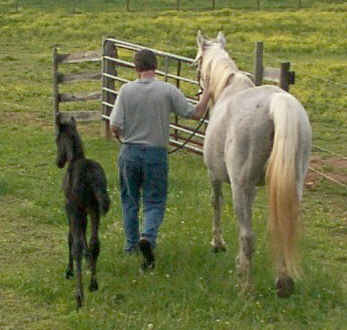
can be stressful and costly. Mares with foals are of special concern,
since foals are particularly vulnerable to disease and injury
when exposed to new horses and environments.
Older or injured mares, or those requiring special care, may also
benefit from staying closer to home during breeding season. The
ability to ship cooled semen makes it possible for breeders to
arrange matings that might otherwise be impractical due to distance,
economics or health.
GOOD CANDIDATES
Many--but not all--horses are good candidates for the use of cooled
transported semen. Both mares and stallions should be in excellent
reproductive health, since fertility problems tend to be compounded
when transported semen is added to the breeding equation. With
shipped semen, there is generally only one opportunity per cycle
to breed a mare. Problem breeders may fare better at the stud
farm, where they can be monitored and serviced at regular intervals
throughout their heat cycles.
INTENSIVE MANAGEMENT
Breeding with cooled transported semen is more management-intensive
than with on-site matings. Timing is critical. For the greatest
chance of pregnancy, a mare must be bred from 12-24 hours before
ovulation to up to six hours after ovulation. From a practical
standpoint, however, once the mare has ovulated, it may be difficult
to determine whether you are still within an acceptable time frame
for fertility. Also, remember cooled stallion semen only has a
shelf life of 24-48 hours.
THE MARE
Prior to breeding season, a mare should have a full reproductive
examination. A uterine biopsy and culture may be indicated to
get a clearer picture of the mare's overall reproductive health.
During breeding season, the mare should be kept where she can
be teased by a stallion on a regular basis in order to detect
the onset of estrus reliably. Once the mare comes into heat, your
equine practitioner will need to predict the onset of ovulation
accurately -- allowing time for the semen shipment to arrive.
The veterinarian will monitor the mare daily or every other day
via rectal palpation and ultrasound throughout her heat cycle
to determine the appropriate time to breed her.
COMMUNICATION & COOPERATION
Good communication between stallion and mare managers is essential.
Coordinating semen shipments will take planning and cooperation.
Most stallion managers plan collection schedules so as not to
overtax a stallion's fertility or reproductive performance. Collections
made 3-4 times per week will accommodate most cooled transported
semen requirements without negatively affecting fertility, while
allowing breeders to meet on-site demands as well. The mare should
be on a regular teasing and examination schedule to reliably ascertain
the proper time to breed. This will allow planning and timely
shipment of cooled semen.
CAVEATS
Many mare owners expect costs to be decreased because of no transport
of the mare. They do not realize that there can be considerable
costs involved with the collection and transporting of semen and
for monitoring the reproductive cycle of the mare and inseminating
her at the appropriate time. For a typical set of circumstances,
i.e., a reasonably fertile mare and good-quality semen, one can
expect pregnancy rates of 55-70% per cycle with chilled semen
(and 35-50% per cycle with frozen semen). The overall pregnancy
rates at the end of the season vary between 50% and 90%, with
an average of about 75%. Of course, some mares lose the pregnancy
and the resulting live foal rate ends up around 65%. Since pregnancy
rates with transported semen are somewhat lower than with on-the-farm
breedings, this means it may take more than one cycle to get a
mare successfully in foal. The mare owner absorbs the cost of
additional semen shipments, veterinary procedures, etc. It also
is important to realize the costs involved with using AI.
A TEAM EFFORT
Breeding with cooled transported semen is a team effort requiring
the expertise of qualified professionals. The goal is to produce
a healthy foal in the most efficient, effective way. To prevent
disappointment, undue expense and loss of valuable time, you must
do your part to ensure success.
THOUGHTS ON HOW TO MANAGE YOUR MARE FOR AI/TS BREEDING...
If you plan to manage your mare's cycle, please notify us well in advance with the date of the particular Monday (Day 14 of the schedule below) that you expect to request semen. This is to ensure that there is no scheduling conflict with the stallion's collection schedule, before you begin hormone supplementation.
Days
1-10:
Suppressing the mare's heat cycle by giving regumate (to prevent
her from coming into heat).
Monday Regumate
Tuesday Regumate
Wednesday Regumate
Thursday Regumate
Friday Regumate
Saturday Regumate
Sunday Regumate
Monday Regumate
Tuesday Regumate
Wednesday Regumate
Thursday Regumate
Day
11:
We stop the regumate on a Thursday and the next day give them
a shot of Lutalyse to bring them into heat.
The reason that we choose Thursday, is that it takes about 4 or
5 days after stopping the regumate and giving the hormone for
them to hopefully make a good size follicle suitable to breed
to. We don't want to make it difficult for the stallion owner
to try and collect and ship on a weekend. If you cycle your mare
to be ready for semen shipment on a Saturday or Sunday, it can't
be collected or sent promptly. Mondays are usually best. So on…
Friday Lutalyse
Day
14:
Starting to check for a nice follicle on Monday morning. Notify
the breeding farm (423-744-9071) with the results.
Scheduling the Vet for Monday morning gives you all week to call
the stallion owner for a semen collection.
Monday Check for follicle, report to stallion owner.
Tuesday Check for follicle, report to stallion owner.
When
the vet detects
one good dominant follicle (~37 mm), contact stallion owner to
request semen, by no later than noon.
Ordering Semen:
Insemination: Inseminate the mare on the day the semen is received.
Discuss this with your vet.
HCG is a hormone that usually gets the mare to ovulate within 36 hours, but can only be used on a limited basis during a season. Some people feel that mares develop antibodies to HCG and after time will not respond as they should. Ovuplant is a pellet that is put under the skin that will do the same thing. Ovuplant is more expensive, though reliable. . Some vets say that if you use Ovuplant, the mare may recycle back slower. I have used both with success.
Ovulation: Have the Vet
check the mare insemination day after insemination to make sure
that she has ovulated.
If she hasn't, you may need to call for more semen; if you try
to contact us before noon, you may be able to get another same-day
collection of semen.
Ultrasound: 14-16 days after insemination we check for pregnancy. Please contact us with the results as soon as you can after having her checked.
If
the mare is not pregnant, she may be developing another follicle
that looks like it is growing; if so, you can ultrasound daily
and reship when it gets big enough without using Regumate. Regumate
won't work if she is too close to coming into heat. If she is
very close, you may be needing to request more semen within a
few days.
If the mare has no follicles, and you can:
a) schedule the vet to restart daily palpation (probably in about
5 days - 7 days) or
b) begin again (with Day 1), to start the process over. There
is cost doing it this way, but some clients feel that in paying
the extra cost for being accurate and doing the best they can
on their end, they recieve fewer blue Equitainers shipments, which
in the long run holds down the cost and makes it easier on us
in managing the stallion collection schedule.
Discuss your options with your vet and please keep us informed
every step of the way.
Breeding by AI/TS can be the easiest way to go, but it definitely requires a team effort. On the stallion end, we would very much appreciate the opportunity to be involved as (i.e. before) decisions are made to manipulate the mare's cycle.
Many thanks to Mary Yeager, who shared her mare management AI/TS breeding experiences with us, enabeling us to put this guide together.